
Makhana Wholesale Price in USA
Home > Makhana Wholesale Price in USA
Makhana Wholesale Price in USA: Complete 2026 Buyer's Guide
The average makhana wholesale price in USA typically falls between $5 and $18 per kg on an FOB basis, depending on grade, packaging format, and order volume — with landed cost (DDP) running 12–20% higher once freight, insurance, and customs duty are included. Buyers ordering full containers generally land on the lower end of the makhana wholesale price range, while smaller trial orders of graded, export-ready fox nuts cost more per unit. This guide breaks down exactly how the wholesale price of makhana in the USA is calculated, what drives the difference between suppliers, and how buyers can negotiate a fair landed cost for their first or next bulk order.
For a broader look at vetting and choosing a supplier beyond price alone, see our complete guide: Wholesale Makhana Supplier in United States.
What Is the Average Makhana Wholesale Price in USA Right Now?
As of the current export season, the makhana wholesale price in USA sits between $5 per kg for smaller broken grades and $18 per kg for extra-large, super-premium grades, quoted FOB from an Indian export facility. Most standard retail-grade orders — the size and quality range most US supermarkets, distributors, and private label brands actually order — fall in the $7 to $13 per kg band. This bulk makhana price per kg USA figure moves with three things: raw material availability after the Bihar harvest season (October to March), current ocean freight rates, and the size grade the buyer is requesting.
It’s worth noting that any number quoted without a shipping term attached (FOB, CIF, or DDP) is incomplete — two suppliers can quote the same per-kg figure and still differ by 15% or more in actual landed cost once freight and duty are factored in. Always ask which term a quote is based on before comparing it against another supplier.
Why Does Makhana Wholesale Price Vary So Much Between Suppliers?
Buyers new to importing makhana are often surprised at how wide the quoted price range can be for what looks like the same product. In practice, four factors explain almost all of that variation, and understanding them upfront saves significant back-and-forth during supplier negotiations.

Grade and Size of the Makhana
Makhana is graded by popped size, typically measured in millimeters, and larger grades command a higher wholesale price because fewer seeds reach that size during processing. A supplier quoting an unusually low price is often quoting a smaller or more broken grade than the buyer assumes, so it’s worth requesting a grade specification sheet alongside any price quote.
Packaging Format
Bulk 20–25 kg export bags are priced lowest per kg since packaging cost is minimal. Retail-ready pouches with printed branding, resealable zippers, and nutrition labeling add $0.50 to $1.50 per kg depending on pouch size and print complexity, which shows up as a higher final wholesale price even though the makhana itself is identical.
Shipping Terms — FOB, CIF, or DDP
As covered in more detail below, the shipping term attached to a quote can shift the effective price by 5% to 20%. A buyer comparing an FOB quote from one supplier against a DDP quote from another is not comparing like for like, even if the headline number looks similar.
Order Volume and MOQ
Like most bulk commodities, makhana wholesale price improves with volume. A 500 kg trial order and a full 20-foot container order (roughly 8–10 metric tons) from the same supplier can differ by 10–15% per kg, since fixed costs like documentation and loading are spread across more units on larger orders.
Supplier Type and Sourcing Layers
Another factor buyers frequently overlook is how many intermediaries sit between the farm and the final export quote. A supplier sourcing directly from farm networks in Bihar can typically offer a more competitive makhana wholesale price than a trading company that buys from a regional aggregator, which in turn buys from individual farmers — each layer in that chain adds its own margin before the product ever reaches an export quote. Asking a supplier directly whether they process in-house or resell from another exporter is a reasonable question that often explains a meaningful part of the price difference between two quotes.
What Is the Makhana Wholesale Price by Grade?
The table below shows typical phool makhana wholesale rate ranges by grade, quoted FOB from India. These are illustrative ranges based on current export patterns — actual pricing fluctuates with harvest yield and seasonal demand, so always request a current quote for exact numbers.
Makhana Grade (Size) | Typical Wholesale Price Range (FOB, per kg) | Common Use Case |
Small (5–8 mm, broken) | $5 – $7 per kg | Processing, flour, snack mix filler |
Medium (9–13 mm) | $7 – $10 per kg | Standard retail snack packs |
Large (14–17 mm) | $10 – $13 per kg | Premium retail, gifting packs |
Extra Large (18mm+) | $13 – $18 per kg | Super-premium, export-grade branding |
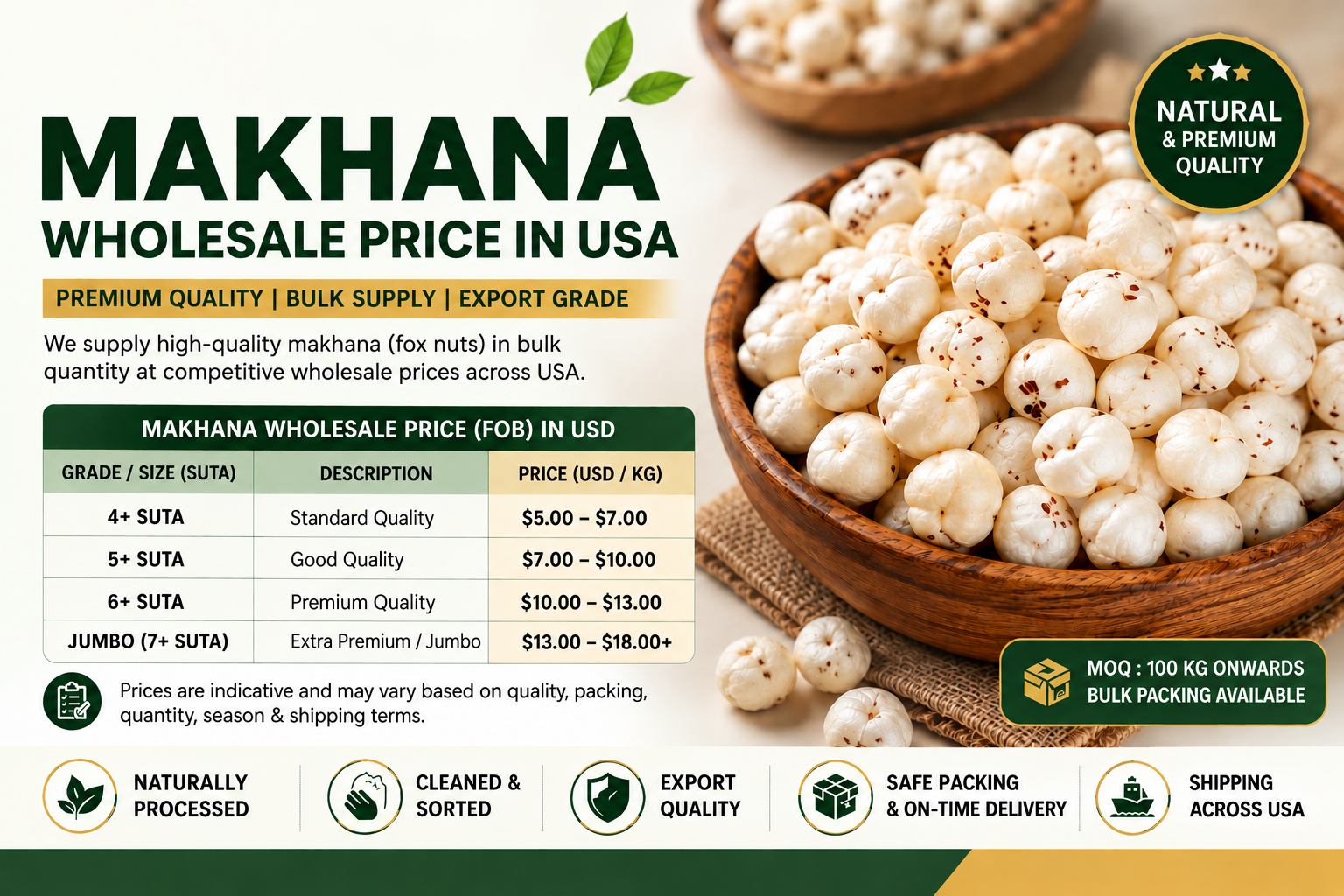
For buyers focused on the US market specifically, the fox nuts wholesale price USA landed figure typically adds $1.50 to $3.00 per kg on top of the FOB numbers above, once ocean freight, marine insurance, and import duty are included — which is why understanding shipping terms matters as much as understanding grade pricing.
How Do FOB, CIF, and DDP Affect Makhana Wholesale Price?
Shipping terms (Incoterms) determine exactly what’s included in a quoted price, and misunderstanding them is the single most common reason buyers feel they were quoted unfairly after the fact.
FOB (Free on Board) Price
An makhana FOB price India quote covers the product cost and loading at the origin port only. The buyer arranges and pays for ocean freight, marine insurance, and customs clearance on arrival. This is typically the lowest headline number, which is why it’s the most commonly advertised price — but it is not the full landed cost.
DDP (Delivered Duty Paid) Price
A DDP quote is the full landed cost — product, freight, insurance, and customs duty — delivered to the buyer’s warehouse door. This is typically 12–20% higher than FOB, but it removes customs complexity entirely, which is why many first-time importers choose DDP despite the higher headline price.
Comparing Shipping Terms at a Glance
One of the biggest challenges U.S. businesses face when importing foods is trust. Delays, quality issues, and lack of compliance can damage brand reputation. Om Exim Traders understands this and prioritizes transparency, reliability, and customer satisfaction. Their growing list of repeat U.S. clients is a testament to their commitment and credibility as a wholesale makhana supplier in United States.
Shipping Term | What’s Included in the Price | Typical Price Impact |
FOB | Product cost + loading at origin port only | Lowest quoted price; buyer adds freight & duty |
CIF | Product cost + freight + insurance to destination port | 5–10% higher than FOB |
DDP | Everything, including customs duty, to buyer’s warehouse | 12–20% higher than FOB |
How to Read a Shipping-Term Price Difference
If two suppliers quote $8/kg FOB and $9.50/kg CIF respectively, they may actually be close to the same landed cost once you add your own freight and insurance to the first quote — the CIF number just makes that cost visible upfront rather than hidden until later.
A Quick Example: 1,000 kg Order
On a 1,000 kg order of medium-grade makhana at roughly $8.50/kg FOB, freight and insurance to a US port typically add $600–$900, and customs duty adds a further percentage based on tariff classification — bringing a rough landed cost to somewhere between $9,800 and $10,500 total, or roughly $9.80–$10.50 per kg landed, before any retail-ready packaging is added.
How Is Makhana Wholesale Price Actually Calculated?
Understanding the cost structure behind a quote helps buyers spot an unrealistic price before committing to a deposit.
Cost Components Behind the Wholesale Price
Raw Material and Processing Cost
This is the base cost of harvesting, popping, and grading the makhana, and it’s the largest component of any quote. It moves with the Bihar harvest yield each season and is the main driver of year-to-year price changes in bulk lotus seeds price USA import quotes.
Grade-Based Cost Difference
Since larger grades require more careful sorting and yield fewer usable seeds per harvest batch, the raw material cost alone can differ by 2–3x between the smallest and largest available grades.
Example: Medium vs Extra-Large Grade
A medium-grade batch might carry a raw material cost of roughly $5–6 per kg, while an extra-large grade batch from the same harvest can carry a raw material cost of $11–13 per kg before any packaging or shipping is added — explaining much of the final price spread buyers see across a supplier’s grade list.
Packaging and Labeling Cost
As covered earlier, this ranges from near-zero for plain bulk export bags to $1.50+ per kg for fully branded, retail-ready pouches with custom printing.
Freight, Insurance, and Customs Duty
This is the variable that shifts most with global shipping conditions — ocean freight rates for India-to-US routes can move 20–30% within a single year depending on fuel costs and container availability, which is why a quote given six months ago may no longer be accurate today.
Makhana Wholesale Price for Retailers vs Distributors vs Private Label Brands
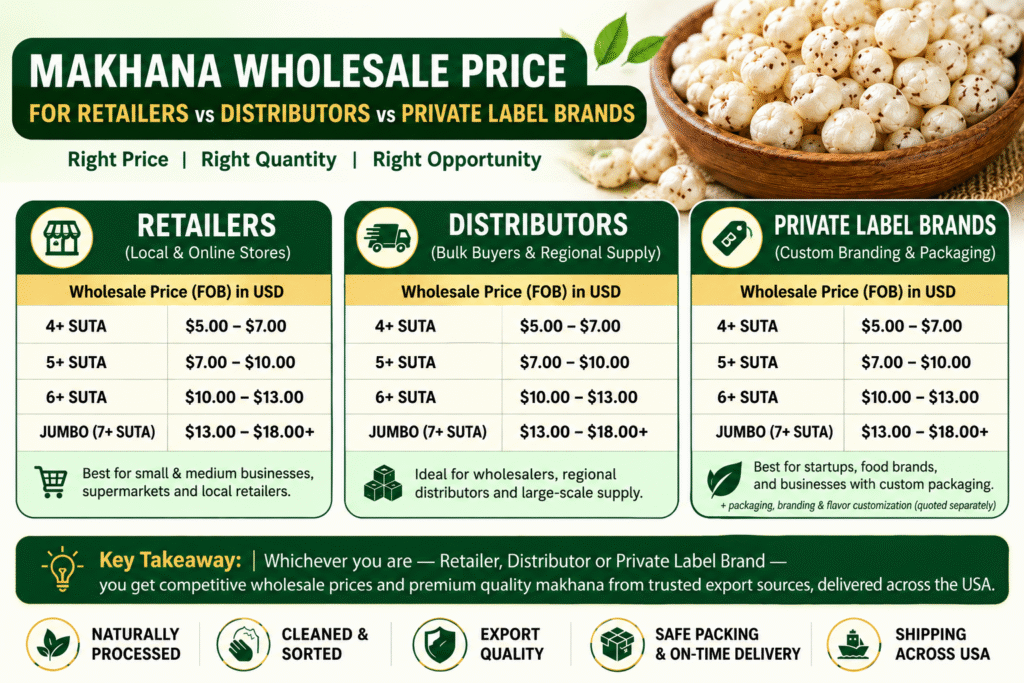
The right price point and shipping term often depends on which type of buyer you are, since order size and margin structure differ significantly across these three groups.
Retailers and Supermarket Chains
Retailers typically want retail-ready packaging included in the quote, which pushes the effective wholesale price of makhana in the USA slightly higher per kg, but removes the need for separate packaging vendors and keeps the supply chain simpler.
Distributors
Distributors buying in larger volumes for regional re-distribution generally negotiate FOB or CIF terms to control freight costs directly, and typically achieve the best per-kg pricing of the three buyer types due to consistent, high-volume ordering.
Private Label Snack Brands
Private label brands often start with a smaller trial order at a higher per-kg price, then negotiate improved wholesale makhana price in the USA terms once reorder volume increases and the supplier relationship is established over two or three shipments. For a full breakdown of MOQ, certifications, and the private label process itself, see our guide on Private Label Makhana Manufacturer for USA Brands.
What Affects Makhana Price Per Kg in Large Bulk Orders?
Beyond grade and shipping terms, a few additional factors specifically affect large-volume orders and long-term supply agreements.
MOQ and Volume Discounts
Most suppliers offer tiered pricing, where the makhana export price per kilogram drops at defined volume thresholds — commonly at 1,000 kg, 5,000 kg, and full-container levels. Asking for a tiered price sheet upfront, rather than a single quote, helps buyers plan future reorders more accurately.
HS Code and Customs Duty Classification
Makhana is typically classified under a specific HS code for processed edible seeds, and the applicable US import duty rate depends on this classification. Buyers should confirm the HS code their supplier is using on export documentation, since an incorrect classification can lead to unexpected duty charges or customs delays after the fact.
Currency and Contract Terms
Most makhana bulk pricing India export quotes are given in USD to simplify comparison for US buyers, but it’s worth confirming whether the price is locked for a fixed period or subject to change with INR-USD exchange rate movement, especially for larger multi-shipment supply agreements.
Payment Terms and Their Effect on Price
Payment structure can also influence the final quote, though it’s a factor many first-time buyers don’t think to negotiate. Suppliers offering a lower advance percentage (for example, 30% deposit with the balance against shipping documents rather than 50% upfront) sometimes quote a slightly higher per-kg price to offset their own cash-flow risk. Buyers with an established track record over multiple orders often unlock both better payment terms and better pricing simultaneously, which is one more reason a smaller trial order with a good working relationship tends to pay off on the second and third reorder.
How to Get the Best Wholesale Makhana Price in USA
A few practical steps consistently help buyers secure better wholesale fox nuts cost USA terms without sacrificing quality or reliability.
- Request a tiered price sheet rather than a single quote, so volume-based savings are visible upfront
- Always confirm which shipping term (FOB, CIF, or DDP) a price is based on before comparing two suppliers
- Ask for a grade specification sheet alongside pricing, since grade differences explain most price gaps between quotes
- Lock pricing in writing for multi-shipment agreements if you’re planning repeat orders over several months
- Start with a smaller trial order to validate quality before committing to full-container volume pricing
- Factor in packaging cost separately if you need retail-ready pouches, rather than assuming it’s included in a bulk per-kg quote
Payment Terms and Their Effect on Price
If a quoted makhana wholesale price is significantly below the ranges outlined in this guide, it’s worth asking directly about grade, moisture content, and certification status before proceeding — an unusually low price is more often explained by a lower grade or missing documentation than by a genuine bargain. A supplier unwilling to share a grade specification sheet or certification documents alongside a very competitive quote is generally a bigger red flag than the price itself, since documentation gaps are what most commonly cause customs delays and unexpected costs after a shipment has already left port.
Makhana Wholesale Price Trends Buyers Should Know
Makhana pricing tends to follow a predictable seasonal pattern tied to the Bihar harvest cycle. Prices are typically most competitive in the months directly following harvest (roughly November through February), when fresh supply is highest, and gradually firm up later in the year as inventory tightens ahead of the next season. Buyers planning large annual volumes often time their primary order for this post-harvest window to secure the most favorable makhana wholesale price in the USA for the year, while keeping a smaller reserve order later in the year to cover any supply gaps.
Year-Over-Year Price Movement
Beyond the seasonal cycle within a single year, makhana pricing has also trended gradually upward over recent years as US demand has grown faster than the pace of new cultivation area coming online in Bihar. This doesn’t mean prices rise every single quarter, but buyers planning multi-year supply agreements should budget for modest annual price increases of roughly 3–8%, rather than assuming a locked-in rate will hold indefinitely without renegotiation.
How Freight Rates Interact with Seasonal Pricing
It’s worth noting that ocean freight rates on the India-to-US route move somewhat independently of the makhana harvest cycle, driven more by global shipping capacity and fuel costs. This means the best time to lock in a low product price (just after harvest) doesn’t always align with the best time to lock in low freight rates, so buyers optimizing for the lowest possible landed cost should track both factors separately rather than assuming they move together.
Why Choose Om Exim Traders for Wholesale Makhana Pricing?
Om Exim Traders sources makhana (fox nuts) directly from farm networks in Bihar, which removes intermediary markups that often inflate wholesale pricing for US buyers working through multiple layers of trading agents. Pricing is quoted transparently across FOB, CIF, and DDP terms with a clear grade specification sheet provided upfront, so buyers can compare the actual wholesale price of makhana in the USA landed cost rather than a misleading headline number. Tiered volume pricing, HACCP-certified processing, and consistent batch grading make it straightforward for retailers, distributors, and private label brands to plan predictable, repeatable bulk orders at a fair and well-documented price.
What Makes a Pricing Relationship Work Long-Term
Beyond the first quote, what tends to matter most for buyers placing repeat orders is consistency — the same grade specification, the same documentation standard, and pricing that moves predictably with the market rather than fluctuating unpredictably between shipments. A supplier that communicates pricing changes ahead of a new harvest season, rather than surprising a buyer at reorder time, is generally the more reliable long-term partner, even if their initial quote isn’t always the absolute lowest on the table. Get in touch for a current price sheet tailored to your order volume and packaging requirements.
Frequently Asked Questions (FAQs) about Makhana Wholesale Price in USA
Wholesale makhana pricing typically ranges from $5 to $18 per kg FOB depending on grade, with landed (DDP) cost running 12–20% higher once freight and duty are added.
No. Smaller broken grades price lowest, while extra-large premium grades can cost more than double the price of standard medium grades due to lower yield during processing.
FOB covers only product cost and origin-port loading, while DDP includes freight, insurance, and customs duty delivered to your warehouse — typically 12–20% higher than FOB but simpler for first-time importers.
Yes, prices are generally most competitive just after the Bihar harvest season (November through February) and gradually firm up later in the year as supply tightens.
Tiered pricing typically starts around 1,000 kg, with further discounts at 5,000 kg and full-container volumes of roughly 8–10 metric tons.
Yes — retail-ready pouches with branding and labeling typically add $0.50 to $1.50 per kg compared to plain bulk export bags.
Compare quotes on the same shipping term (FOB, CIF, or DDP), request a grade specification sheet, and check that certifications like HACCP are documented before comparing price alone.
An unusually low quote is most often explained by a smaller or more broken grade, missing certification documentation, or an incomplete shipping term rather than a genuine cost advantage.
Order Now
+91 9040030306
info@omeximtraders.com