
Lijjat papad wholesale price guide
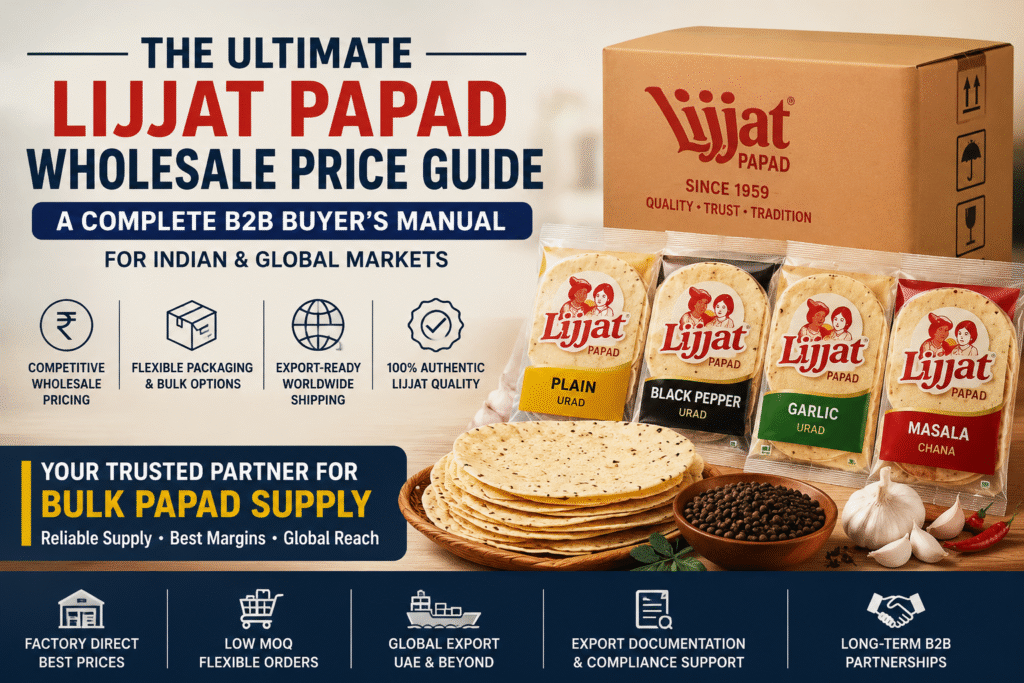
Lijjat Papad Wholesale Price Guide Home > Lijjat Papad Wholesale Price Guide The Ultimate Lijjat Papad Wholesale Price Guide The global appetite for authentic Indian FMCG products has skyrocketed over the last decade, and standing firmly at the pinnacle of this culinary demand is the humble, crispy, and universally loved Indian papadum. Whether it is a traditional household dinner in Mumbai, a bustling street-side food stall in Delhi, or a premium fine-dining Indian restaurant in Dubai, papad remains an indispensable culinary accompaniment. For businesses operating within the FMCG supply chain, grocery retail, hospitality, or international food import-export sectors, understanding the financial dynamics of this product is crucial. Navigating these dynamics requires a reliable Lijjat papad wholesale price guide to understand structural costs, optimize procurement budgets, establish robust profit margins, and partner with dependable supply chain allies like OM Exim Traders. This specific Lijjat papad wholesale price guide is designed to give global buyers a complete analytical map of the industry. Sourcing these high-demand items requires more than just finding a vendor; it necessitates a deep understanding of standard wholesale Lijjat papad rates, volatile regional logistics, bulk scaling factors, and international export compliances. This extensive industry manual provides an analytical breakdown of market economics, procurement strategies, and global shipping setups. It serves as a definitive Lijjat papad wholesale price guide to help smart B2B buyers navigate the landscape, optimize operational costs, and maximize profitability. Reading through a structured Lijjat papad wholesale price guide helps businesses eliminate intermediate losses and secure higher profit percentages. Introduction to the Lijjat Papad Wholesale Industry The Indian papad industry is a brilliant example of grassroots entrepreneurship, cultural heritage, and incredible commercial scale. At the center of this multi-million dollar sector is the Shri Mahila Griha Udyog Lijjat Papad, an extraordinary cooperative movement that empowered thousands of women across India while creating one of the most recognizable snack brands in South Asia. What started as a modest venture with a borrowed sum of just eighty rupees has evolved into a dominant market force. For commercial buyers, wholesalers, and international food importers, utilizing a Lijjat papad wholesale price guide helps clarify how this massive scale impacts unit economics across regional supply lines. Operating successfully within the Indian papad wholesale market requires recognizing that this is a high-volume, steady-margin business. Unlike niche gourmet items that carry premium markups but suffer from low turnover, fast-moving consumer goods like Lijjat papad depend entirely on rapid inventory rotation. Because consumers actively seek out this specific brand by name, wholesale buyers do not need to spend heavily on marketing or consumer education. Instead, the core operational focus must shift entirely toward sourcing efficiency, minimizing domestic transport costs, securing reliable allocation from a stable papad manufacturing company India, and tracking the Lijjat papad distributor price to protect your bottom line against sudden market shifts. A well-researched Lijjat papad wholesale price guide serves as an essential tool for training procurement teams. Current Papad Market Trends in India The Indian snack and traditional savory market is undergoing a major structural transformation driven by changing consumer habits, modern retail setups, and rising international interest. Today’s buyers are moving away from unbranded, open-air loose goods in favor of hygienic, standardized, and laboratory-tested branded items. This shift has triggered an unprecedented surge in demand across the papad wholesale business, as modern supermarkets, boutique grocery stores, and cloud kitchens refuse to stock uncertified foods that present potential health or consistency risks. Keeping a modern Lijjat papad wholesale price guide handy allows storefront owners to anticipate these demand shifts and secure product inventory before seasonal shortages occur. Additionally, the integration of traditional Indian side dishes into global culinary spaces has expanded the market beyond just regional Indian households. International fusion restaurants, European vegan chains, and cross-cultural snack brands are increasingly utilizing crispy papads as a gluten-free, low-calorie alternative to traditional taco shells, chips, or crackers. This expanding consumer base guarantees that wholesale buyers entering this space enjoy sustained, long-term market velocity, shielding them from the sharp demand drops often seen in cyclical or trend-heavy food sectors. Complete Lijjat Papad Wholesale Price Guide When developing a commercial procurement budget or executing a Lijjat papad bulk purchase, buyers must realize that wholesale pricing fluctuates based on localized distribution networks, bulk volume tiers, transport distances, and specific product flavors. To give procurement managers, supermarket category heads, and export firms a clear operational baseline, the following comprehensive pricing matrix outlines estimated bulk pricing structures observed across the primary papad wholesale market India. Estimated Bulk Pricing Matrix Papad Variety & Flavor Pack Weight Case Configuration Wholesale Price Per Case Wholesale Price Per KG Udad Plain Papad 200g 80 Packs / Carton ₹2,800 – ₹3,100 ₹175 – ₹193 Udad Black Pepper (Kali Mirch) 200g 80 Packs / Carton ₹2,900 – ₹3,200 ₹181 – ₹200 Udad Garlic (Lasun) Papad 200g 80 Packs / Carton ₹3,050 – ₹3,350 ₹190 – ₹209 Moong Special Papad 250g 60 Packs / Carton ₹2,850 – ₹3,150 ₹190 – ₹210 Moong Punjabi Masala 250g 60 Packs / Carton ₹2,950 – ₹3,250 ₹196 – ₹216 Chana Masala Papad 200g 80 Packs / Carton ₹3,100 – ₹3,400 ₹193 – ₹212 Jeera (Cumin) Papad 200g 80 Packs / Carton ₹2,950 – ₹3,200 ₹184 – ₹200 Note: The pricing figures provided in this comprehensive Lijjat papad wholesale price guide are realistic industry estimates compiled from major trading hubs. Actual spot pricing can vary based on raw material costs, seasonal changes, transport costs, and order volumes. For real-time commercial quotes tailored to your delivery region, consulting an established sector specialist like OM Exim Traders is highly recommended. When analyzing this Lijjat papad wholesale price guide, look closely at the cost breakdown per kilogram. While retail buyers often pay a premium for individual small packs, commercial entities purchasing at a Lijjat papad carton price level unlock significant volume discounts. These discounts form the foundation of downstream profitability for regional sub-distributors, supermarket chains, and international maritime exporters alike. Current Papad Market Trends in India The Indian snack and traditional savory