
How to Import Makhana from India to USA
Home > How to Import Makhana from India to USA
How to Import Makhana from India to USA: Complete Step-by-Step Guide
Learning how to import makhana from India to USA comes down to five core stages: finding a certified exporter, confirming FDA and HACCP documentation, agreeing on shipping terms (FOB, CIF, or DDP), filing the correct customs paperwork, and clearing the shipment through US Customs and Border Protection. The full process typically takes 90 to 120 days from initial supplier contact to product arriving at a US warehouse, and missing even one document — most commonly the FDA Prior Notice — is the single most common reason shipments get delayed at port. This guide walks through exactly how to import makhana from India to USA, step by step, including every document required and what it actually costs.
Why Import Makhana from India Specifically?
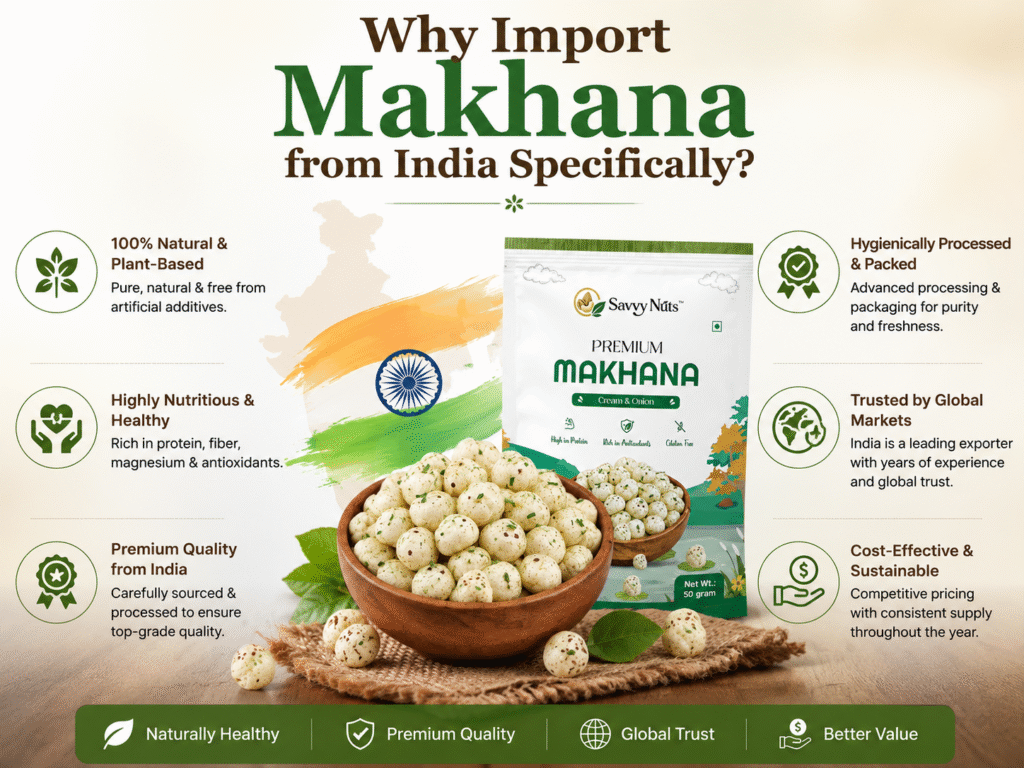
Before getting into the process itself, it’s worth understanding why India — and specifically the state of Bihar — is the default sourcing origin for nearly every makhana import into the US. Bihar accounts for the large majority of global makhana cultivation, given the specific wetland growing conditions the Euryale ferox plant requires. This concentration means pricing, grading standards, and export infrastructure are all built around Bihar-based processing facilities, so almost any serious conversation about importing makhana starts with identifying a facility in this region.
What This Means for Sourcing Strategy
Because supply is so concentrated in one region, buyers researching how to import makhana from India to USA don’t typically need to compare origin countries the way they might for a more geographically distributed commodity. The more relevant comparison is between individual exporters within Bihar — their certification status, grading consistency, and export experience — rather than weighing India against alternative source countries with meaningful production volume.
What Do You Need Before Starting the Import Process?
A few pieces need to be in place before reaching out to an exporter, especially for anyone new to food importing.
Registering as an Importer of Record
US customs law requires every commercial shipment to have a designated importer of record — either your own registered business or a licensed customs broker acting on your behalf. This isn’t optional paperwork; without it, a shipment cannot legally clear customs, so this should be sorted out before placing a deposit with any supplier.
Understanding FDA Registration Requirements
As the US-side importer, you’ll need to confirm your own food facility registration status if you’re warehousing or repackaging product domestically, and you’ll separately need to verify that your exporter’s facility in India holds valid FDA Food Facility Registration — these are two different registrations covering two different parties in the transaction.
Choosing a Reliable Exporter in India
This is where most of the actual work in learning how to import makhana from India to USA happens. A reliable exporter should provide a grade specification sheet, current HACCP or ISO 22000 certification, and sample product before any deposit is made. Buyers unfamiliar with the space often skip this verification step and pay for it later in the form of shipment delays or inconsistent quality.
Market Insights: Makhana’s Growing Space in the U.S. Food Industry
- Supermarkets & Health Stores: Big chains like Whole Foods, Sprouts, and Trader Joe’s are increasingly open to stocking global health snacks, making room for makhana products.
- E-commerce Growth: Platforms like Amazon and Walmart Online are fueling direct-to-consumer sales of makhana brands.
- Food Service Sector: Restaurants and cafés are experimenting with makhana as crunchy salad toppings, cereal mix-ins, and guilt-free appetizers.
- Private Label Brands: U.S. health snack companies are collaborating with bulk makhana suppliers in USA like Om Exim Traders to launch private-label makhana products.
Setting a Realistic Order Volume for Your First Import
First-time importers often default to either an overly cautious sample-size order that isn’t commercially useful, or an overly ambitious full-container order before the supplier relationship is tested. A more practical middle ground is a trial order in the 500–1,000 kg range — large enough to be commercially meaningful for a small retailer or distributor, small enough to limit financial exposure if the first shipment reveals any issues with grade consistency or documentation.
What Documents Are Required to Import Makhana into the USA?
This is the part of the process most first-time importers underestimate. The table below covers every document typically required, who is responsible for preparing it, and what it’s actually for.
Document | Who Prepares It | Purpose |
Commercial Invoice | Exporter (India) | States product value, quantity, and terms of sale for customs valuation |
Packing List | Exporter (India) | Details exact contents, weight, and packaging of each shipment unit |
Bill of Lading | Shipping line / freight forwarder | Serves as the shipment’s transport contract and title document |
Certificate of Origin | Exporter / Chamber of Commerce (India) | Confirms the product was manufactured in India for customs and tariff purposes |
FDA Prior Notice | Importer or customs broker (USA) | Filed before shipment departure to alert the FDA of an incoming food shipment |
FDA Facility Registration | Exporter’s facility (India) | Confirms the processing facility is registered to export food to the US |
HACCP / ISO 22000 Certificate | Exporter’s facility (India) | Demonstrates food safety management compliance at the processing facility |
FSVP Documentation | Importer (USA) | Confirms the US importer has verified the foreign supplier meets US safety standards |
Customs Entry (CBP Form 3461) | Customs broker (USA) | Filed with CBP to formally clear the shipment through US customs |
Of everything on this list, the FDA Prior Notice is worth flagging specifically — it must be filed before the shipment departs India, not on arrival, and missing this single filing is the most common reason shipments get flagged for extended review at US customs.
Who Actually Files Each Document
It’s worth clarifying upfront that not every document on this list is your responsibility as the importer. The exporter typically handles the commercial invoice, packing list, and certificate of origin as part of standard export practice. The FDA Prior Notice can be filed by the exporter, the importer, or a customs broker, depending on the working arrangement — but someone needs to explicitly own this step, since it’s the one most commonly assumed to be “handled by the other side” when in fact neither party has filed it.
How to Import Makhana from India to USA — Step-by-Step Process
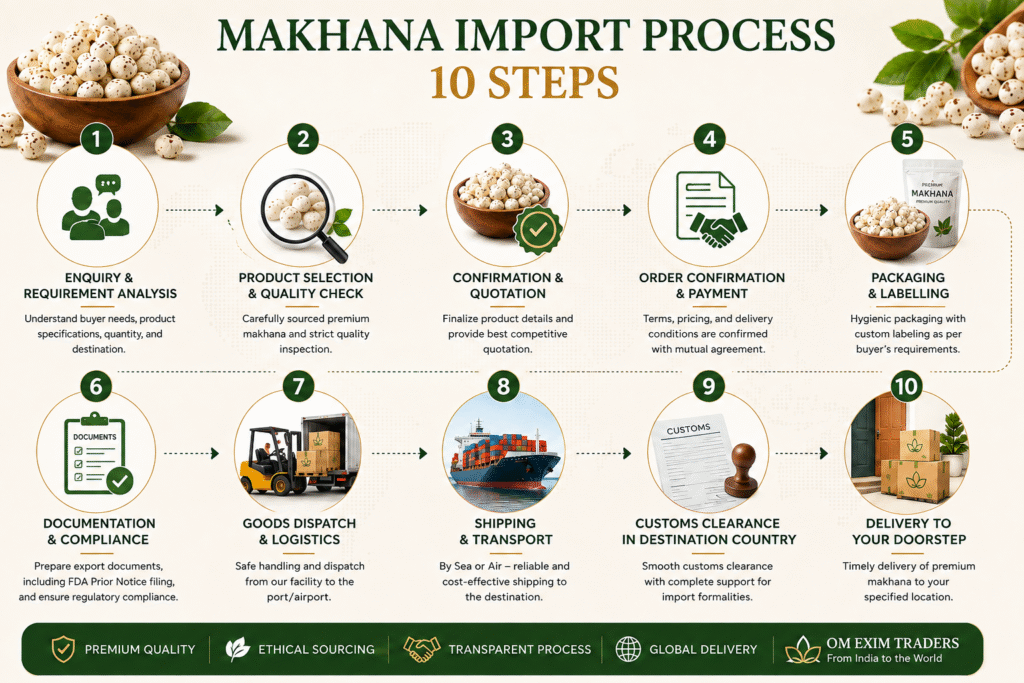
With documentation requirements covered, here’s how the end-to-end process actually unfolds in practice, from first contact with a supplier to product sitting in a US warehouse.
The Full Import Process
Step 1 — Identify and Vet a Supplier
Start by researching exporters based in or sourcing directly from Bihar, since this concentration of supply means the most established, export-experienced facilities tend to be located there. Request their FDA registration number and current HACCP certificate immediately — a supplier who hesitates or delays sharing this information is worth deprioritizing, regardless of how attractive their initial price quote looks. Confirm they can supply the specific grade and packaging format you need, and ask how long they’ve been exporting to the US specifically, since domestic-market-only processors sometimes lack experience with US-specific documentation requirements. This vetting stage typically takes one to two weeks if done thoroughly, and rushing it is the single most common source of problems that surface later in the process.
Step 2 — Request Samples and a Formal Quote
Once you’ve shortlisted one or two suppliers, request physical samples shipped for quality evaluation rather than relying on photos or a verbal description of grade quality. Alongside the sample request, ask for a written quote that explicitly states whether pricing is FOB, CIF, or DDP, and request a breakdown showing what’s included at each stage — product cost, packaging, freight, and any handling fees. It’s worth requesting quotes from more than one supplier at this stage even if you have a frontrunner, since having a comparison point strengthens your negotiating position and gives you a sense of whether a quote is priced fairly for the grade and volume you’re requesting.
Step 3 — Confirm Order and Sign a Proforma Invoice
Once a sample is approved, the exporter issues a proforma invoice — a preliminary but binding document confirming exact quantity, grade specification, packaging format, unit price, total order value, and payment terms. Read this document carefully before signing, since it becomes the reference point for every subsequent step, including the final commercial invoice used for customs clearance. Any discrepancy between the proforma invoice and what eventually ships can create documentation mismatches that trigger exactly the kind of customs delay discussed later in this guide, so it’s worth double-checking every line item rather than treating this as a formality.
Step 4 — Arrange Payment Terms
Most India-to-USA food shipments follow a partial advance payment structure, commonly 30–50% paid upfront to confirm the order and begin production, with the balance due against shipping documents once the goods are loaded and the bill of lading is issued. Exact terms vary by supplier and by your order history — first-time buyers should expect to pay a higher advance percentage than an established buyer with several successful shipments behind them. It’s worth clarifying the payment method (wire transfer is standard) and confirming who absorbs any international transfer fees, since this is a small but easily overlooked detail that occasionally causes friction at settlement time.
Step 5 — Production and Quality Checks
With payment confirmed, the exporter begins processing and grading the order to the agreed specification. Reputable facilities run moisture content and pop ratio checks at each production batch, since makhana with excess moisture is significantly more prone to spoilage or mold growth during the multi-week ocean transit ahead. If your order is large enough or your relationship with the supplier is new, it’s reasonable to request photos or a video of the production run, or even a third-party pre-shipment inspection for a first large order — an added cost, but one that meaningfully reduces risk on an order you haven’t yet seen firsthand.
Step 6 — Export Documentation Preparation
Once production is complete, the exporter prepares the core export documents — commercial invoice, packing list, and certificate of origin — and coordinates with a freight forwarder to book cargo space and container loading. This is also the point where the exporter should confirm the correct HS code classification with you or your customs broker, since this detail flows into every downstream document and directly affects the duty rate applied when the shipment reaches the US. Confirm you’ve received copies of these documents before the container is sealed and loaded, rather than waiting until the shipment is already at sea to review them.
Step 7 — File FDA Prior Notice
Before the shipment physically departs India, someone — the exporter, the importer, or a customs broker acting on either party’s behalf — must file the FDA Prior Notice, which alerts the FDA to the specific details of the incoming food shipment. This filing is time-sensitive: it must be submitted within a defined window before arrival, and it cannot be filed after the fact to correct an oversight. Because responsibility for this step is sometimes unclear between exporter and importer, it’s worth explicitly confirming in writing, before production even begins, exactly who owns this filing for your shipment.
Step 8 — Ocean Freight to a US Port
Once loaded, the container begins its ocean transit, typically taking 25 to 40 days from an Indian port to a US port, depending on the specific origin and destination ports and whether the routing includes a transshipment stop at an intermediate port. During this window, it’s worth tracking the shipment using the bill of lading number provided by the freight forwarder, both for your own planning purposes and so you can alert your customs broker with enough lead time to prepare the entry filing before the container actually arrives.
Step 9 — US Customs Clearance
On arrival, your customs broker files the formal entry with US Customs and Border Protection, submitting the commercial invoice, packing list, and certificate of origin, and paying any applicable duty calculated from the shipment’s HS code classification. If all documentation is accurate and complete, this stage typically takes a few days. If a discrepancy or missing document triggers a hold, refer back to the customs-hold section earlier in this guide for how that process typically unfolds and how quickly it’s usually resolved.
Step 10 — Delivery to Your Warehouse
Once customs clears the shipment, it moves by truck from the port to its final destination — a leg that can take anywhere from a single day to about a week depending on how far your receiving warehouse is from the port of entry. This is also the point to do a final quality check against the original sample and grade specification before accepting the delivery, since this is your last practical opportunity to flag any discrepancy directly against the documented order before the product enters your own inventory and distribution chain.
How Long Does the Full Process Take?
Added together, most buyers should plan for 90 to 120 days from first supplier contact to product available for sale — roughly one to two weeks for supplier vetting, one to two weeks for sampling and order confirmation, two to three weeks for production, 25 to 40 days for ocean freight, and one to two weeks for customs clearance and final delivery. First-time importers should budget toward the longer end of this range, since unfamiliarity with the process tends to add small delays at multiple stages, while repeat orders with an established supplier typically move noticeably faster once the documentation relationship is already in place.
What Certifications Does the Exporter Need to Have?
Certification gaps are the second most common cause of import delays after missing Prior Notice filings, so it’s worth understanding exactly what to check for.
FDA Food Facility Registration
Required for any facility exporting food into the US, and renewed every two years. This should be the very first thing confirmed before any deposit is paid.
HACCP Certification
Hazard Analysis Critical Control Points certification demonstrates that the processing facility manages food safety risks systematically, from raw material intake through final packaging.
ISO 22000 Certification
A broader food safety management system certification that many — though not all — exporters hold alongside HACCP. It’s a positive signal but not strictly required if HACCP certification is already in place.
FSVP Compliance (Importer's Responsibility)
The Foreign Supplier Verification Program places responsibility on the US-side importer to verify that their foreign supplier meets US food safety standards. This is technically the importer’s obligation, not the exporter’s, but a good exporter will readily supply the documentation needed to satisfy it.
How Much Does It Cost to Import Makhana from India to USA?
Cost depends heavily on which shipping term a quote is based on, so understanding the three common options matters as much as the per-kg product price itself.
FOB (Free on Board)
Covers product cost and loading at the origin port only. The buyer arranges and pays for ocean freight, insurance, and customs clearance separately — this is typically the lowest headline price.
CIF (Cost, Insurance, Freight)
Adds freight and insurance to the destination port on top of the FOB price, typically running 5–10% higher, with the buyer still handling customs clearance from the port onward.
DDP (Delivered Duty Paid)
The full landed cost — product, freight, insurance, and duty — delivered to the buyer’s warehouse door, typically 12–20% higher than FOB but simplest for a first import.
A Practical Cost Example
On a 1,000 kg trial order of medium-grade makhana at roughly $8.50/kg FOB, freight and insurance to a US port typically add $600 to $900, with customs duty adding a further percentage based on tariff classification — bringing a rough landed cost to somewhere between $9,800 and $10,500 total.
Why the Shipping Term Matters More Than the Product Price Alone
Two exporters can quote a nearly identical FOB price and still result in a meaningfully different total cost once freight, insurance, and customs handling are added — always request a full landed-cost estimate rather than comparing FOB numbers in isolation.
Note on Currency and Payment Timing
Most quotes are given in USD for simplicity, though it’s worth confirming whether pricing is locked for a fixed period, since ocean freight rates on the India-to-US route can shift meaningfully within a single year.
Additional Costs Beyond the Shipping Quote
Buyers new to importing food products from India to USA sometimes budget only for the supplier’s quote and freight, overlooking a few smaller recurring costs: customs broker fees (typically a flat fee per entry), port handling and terminal fees, and warehouse storage charges if a shipment sits at port longer than the free storage period due to a documentation hold. None of these individually is large, but together they can add several hundred dollars to the total landed cost of a first shipment.
What's the HS Code and Import Duty for Makhana?
Makhana is typically classified under a specific Harmonized System (HS) code for processed edible seeds when entering the US. The applicable import duty rate depends on this exact classification, and using an incorrect code — even unintentionally — can lead to unexpected charges or a customs hold after the shipment has already departed.
Confirming the Correct Classification
A customs broker or your exporter’s documentation team should confirm the exact HS code being used on export paperwork before the shipment leaves India, since correcting a misclassified entry after arrival is far more time-consuming than confirming it upfront.
Sea Freight vs Air Freight — Which Should You Use to Import Makhana?
Most guidance on how to import makhana from India to USA assumes sea freight by default, since it’s the standard method for bulk food imports, but it’s worth understanding when the alternative makes sense.
Sea Freight (Standard Method)
Sea freight is the default choice for makhana imports because of cost efficiency at volume — a full or partial container load costs a fraction per kg compared to air freight, and the 25–40 day transit time is manageable for a shelf-stable product with a 12–18 month shelf life. The vast majority of commercial makhana shipments into the US move by sea.
Air Freight (Exception Cases)
Air freight costs significantly more per kg — often 4 to 8 times the equivalent sea freight rate — but cuts transit time down to a matter of days rather than weeks. This is rarely justified for a routine bulk order, but occasionally makes sense for a small, time-sensitive sample shipment or an urgent restock when a retailer is at risk of a stockout and the cost premium is acceptable relative to the lost sales from an empty shelf.
When Air Freight Makes Sense
As a rough guideline, air freight is worth considering only for shipments under roughly 50–100 kg where speed matters more than cost — anything beyond that volume, the cost premium usually outweighs the benefit of a faster delivery, and sea freight remains the more sensible default even when a buyer is in a hurry.
What Happens If Your Shipment Gets Held at Customs?
Even with careful preparation, it helps to understand what actually happens if a shipment does get flagged, rather than treating it as a worst-case scenario that ends the transaction.
Common Reasons for a Customs Hold
- Missing or late FDA Prior Notice filing
- Mismatched information between the commercial invoice and packing list
- Incorrect or ambiguous HS code classification
- Expired or missing HACCP/facility registration documentation
- Random compliance spot-checks, which occur independent of documentation quality
How a Documentation Hold Gets Resolved
In most cases, a hold means providing the missing or corrected document to your customs broker, who resubmits it to CBP for review. This typically resolves within a few business days to about a week, though it can extend longer during high-traffic periods at a busy port. The shipment remains in a bonded storage area at the port during this time, which is why confirming documentation before departure is so much less costly than fixing it after arrival.
Estimated Cost and Timeline Impact
Beyond the delay itself, an extended hold can trigger demurrage charges (storage fees for a container sitting at port beyond its free period), which typically start accruing after 3–5 free days and can add up meaningfully if a hold drags on for two or three weeks. This is the practical, financial reason documentation accuracy matters more than almost any other single factor in the entire import process.
How to Scale from a Trial Order to Regular Import Shipments
Once a first shipment clears successfully, most buyers want to understand how to move from a one-off trial order to a predictable, repeatable import schedule.
Signs You're Ready to Scale Up
- Your trial order sold through at the volume and price point you expected
- Grade and packaging consistency matched what was sampled and quoted
- Documentation and customs clearance went smoothly with no unexpected holds
- You have warehouse capacity and cash flow to support a larger, less frequent order
Negotiating Better Terms on Repeat Orders
Suppliers are generally more willing to improve pricing, payment terms, or shipping arrangements once a buyer has demonstrated reliability through a smooth first transaction. It’s reasonable to directly ask about volume-tier pricing, extended payment terms, or a shift from DDP to FOB (for buyers ready to manage freight themselves) once a working relationship is established over two or three shipments.
Setting Up a Standing Purchase Arrangement
For buyers moving to recurring quarterly or biannual orders, it’s worth formalizing expectations in writing — agreed grade specifications, a pricing structure that adjusts predictably with the harvest cycle rather than being renegotiated from scratch each time, and a standard document checklist both sides already know to prepare. This reduces the administrative overhead of each subsequent order significantly compared to the first.
Glossary of Common Makhana Import Terms
For buyers newer to importing, a few terms come up repeatedly throughout this process. Here’s a quick reference.
Glossary of Common Makhana Import Terms
Key Terms Explained
- FOB (Free on Board) — Pricing that covers product cost and origin-port loading only; buyer arranges freight from there
- CIF (Cost, Insurance, Freight) — Pricing that adds freight and insurance to the destination port
- DDP (Delivered Duty Paid) — Full landed cost, including duty, delivered to the buyer’s warehouse
- Importer of Record — The legally responsible party for a shipment’s compliance with US import law
- FDA Prior Notice — A mandatory filing alerting the FDA to an incoming food shipment before it departs origin
- HACCP — Hazard Analysis Critical Control Points, a food safety management certification
- FSVP — Foreign Supplier Verification Program, the importer’s obligation to verify supplier compliance
- HS Code — Harmonized System code used to classify goods for customs duty purposes
- Bill of Lading — The shipment’s transport contract and title document issued by the carrier
- Demurrage — Storage fees charged when a container remains at port beyond its free period
- MOQ — Minimum Order Quantity, the smallest order size a supplier will accept
- Customs Broker — A licensed professional who files import documentation on behalf of an importer
Why Import Makhana Through Om Exim Traders?
For buyers going through this process for the first time, working with an exporter that handles documentation proactively — rather than reactively when a customs officer asks for it — makes the biggest practical difference between a smooth 90-day import and a shipment stuck at port for weeks. Every stage covered in this guide, from supplier vetting through customs clearance, is easier when the exporter side of the relationship is already organized around US import requirements rather than treating them as an afterthought.
Direct Sourcing from Bihar Farms
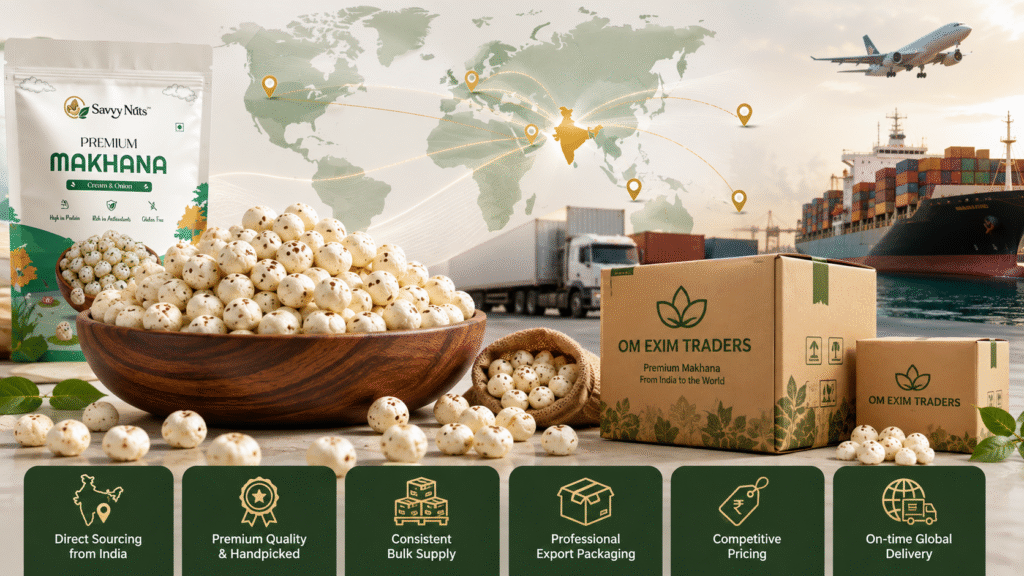
Om Exim Traders sources makhana (fox nuts) directly from farm networks in Bihar, cutting out the multiple trading layers that often sit between a grower and an export-ready shipment at other suppliers. This direct relationship matters in two concrete ways for a buyer going through the import process: grading stays consistent from one order to the next, since the same farms and processing standards are used batch after batch, and pricing reflects the actual cost of production rather than accumulated intermediary markups. For a first-time importer specifically, consistent grading also means the sample you approve in Step 2 is a reliable predictor of what actually arrives in Step 10, which is not something every supplier in this market can promise.
Documentation Handled Before You Ask
Every shipment is backed by HACCP-certified processing and full grading documentation, prepared well ahead of departure rather than assembled hastily once a shipment is already booked. FDA Prior Notice filing, certificate of origin, and facility registration are treated as standard steps in every order rather than items a buyer needs to chase down or double-check — which directly addresses the single biggest risk covered earlier in this guide, since documentation gaps are the leading cause of customs holds and demurrage charges at US ports. For a first-time buyer still learning which document belongs to which stage of the process, working with a supplier that already has this system in place removes a significant portion of the risk that would otherwise fall on the buyer’s side of the transaction.
Shipping Terms That Fit Your Experience Level
FOB, CIF, and DDP are all available, which matters because the right shipping term genuinely depends on how much of the logistics process a buyer wants to manage directly. A first-time importer with no existing customs broker relationship can start with a DDP arrangement, where freight, insurance, and duty are all handled and bundled into a single delivered price — removing most of the complexity discussed in the shipping-cost section of this guide. As a buyer places repeat orders and builds familiarity with the process, or brings on their own customs broker, shifting to FOB typically unlocks better per-kg pricing, since the buyer is absorbing more of the logistics work themselves in exchange for a lower product cost. This flexibility means the same supplier relationship can support a buyer all the way from their very first trial order through to a mature, high-volume import operation.
Related Guides for New Importers
Depending on exactly where you are in your sourcing decision, a couple of related guides may be more directly useful than this one, or worth reading alongside it.
For a broader look at supplier evaluation and sourcing across the US market generally — useful if you haven’t yet settled on India as your sourcing origin, or want a wider comparison of what to look for in any bulk makhana supplier — see our guide on Wholesale Makhana Supplier in United States.
Brands planning to launch their own branded product line, rather than importing generic bulk makhana for resale, will likely get more direct value from our dedicated guide on Private Label Makhana Manufacturer for USA Brands, which covers MOQ, custom flavor development, and packaging requirements specific to that path — details this import-focused guide doesn’t go into.
Start Your First Import
If you’re ready to move forward, get in touch for a sample and a formal quote — the same first two steps covered earlier in this guide. When reaching out, it’s worth having your target grade, approximate order volume, and preferred shipping term (or simply that you’re unsure and want a recommendation) ready, since this lets the conversation move directly to a useful quote rather than a lengthy back-and-forth on basics. Once you’ve worked through how to import makhana from India to USA a first time, reorders move considerably faster, since the documentation relationship, grade preferences, and payment terms are already established — most of the friction described throughout this guide is specific to a first shipment, not something that repeats on every order after.
Frequently Asked Questions (FAQs) about How to Import Makhana from India to USA
Begin by registering as an importer of record (or working with a licensed customs broker), then identify an FDA-registered exporter in Bihar and request samples and a formal quote.
Commercial invoice, packing list, bill of lading, certificate of origin, FDA Prior Notice, FDA facility registration, and HACCP certification are the core documents required.
Most first-time imports take 90 to 120 days from initial supplier contact to product available for sale, including sampling, production, ocean freight, and customs clearance.
FOB covers product cost only at origin; CIF adds freight and insurance to the destination port; DDP includes everything, including duty, delivered to your warehouse door.
You need the exporting facility to hold FDA Food Facility Registration and you must file an FDA Prior Notice before each shipment departs — there's no separate product-specific FDA approval required for makhana itself.
Makhana falls under a specific Harmonized System code for processed edible seeds; your customs broker or exporter should confirm the exact classification for your shipment before departure.
Technically yes, but most first-time importers use a licensed customs broker to file entry documents correctly, since errors in self-filed customs paperwork are a common cause of shipment delays.
Direct import orders typically start around 500 kg for a custom grade or private label order, though some exporters accept smaller trial orders for first-time buyers.
Most holds are resolved by providing the missing or corrected document to your customs broker within a few business days to a week; the shipment stays in bonded storage at port until cleared.
Once a trial order clears smoothly and sells through as expected, most buyers can negotiate improved pricing or terms and set up a standing agreement with the same supplier for recurring orders.
Order Now
+91 9040030306
info@omeximtraders.com